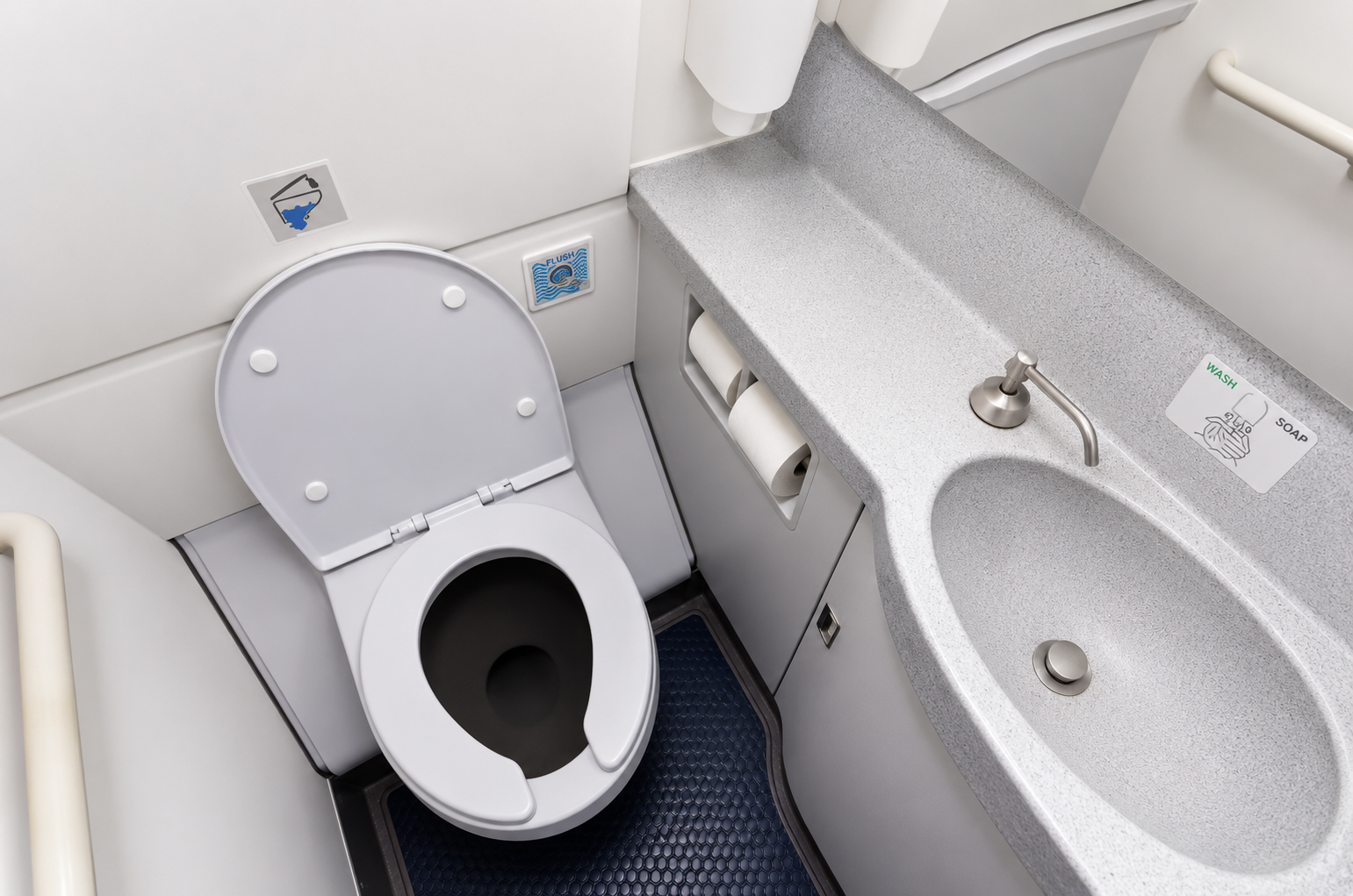
If you have ever used an airplane lavatory, you have seen it: that vivid blue liquid pooled at the bottom of the toilet bowl. It smells faintly antiseptic. It is designed to deodorize, sanitize, and break down waste in a sealed holding tank. And for the scientists trying to extract pathogen DNA from that same tank, it is a significant problem.
This is the story of the blue liquid problem — and how researchers solved it to make aircraft wastewater surveillance genuinely work.
What makes aircraft wastewater different
Most wastewater-based epidemiology (WBE) programs around the world sample municipal sewage — the waste that flows from homes and businesses into shared treatment systems. That wastewater is highly diluted by the time it reaches a sampling point, meaning the concentration of any individual inhibitor is low.
Aircraft lavatory wastewater is the opposite. Researchers at the University of Queensland and Critical Reviews in Environmental Science and Technology describe it as a unique "blackwater" matrix: highly concentrated, undiluted human waste collected into a sealed holding tank with almost no mixing with sink or greywater [1]. When 300 passengers use the lavatories over a 12-hour flight, that tank holds an exceptionally dense biological sample — which is exactly what makes it useful for surveillance, and simultaneously what makes it technically challenging.
The key chemical adversaries are the disinfectants. Aircraft lavatory systems commonly use formaldehyde-based compounds and quaternary ammonium compounds (QACs), sometimes known as "quats." These chemicals are highly effective sanitizers — they break apart lipid membranes and denature proteins. Unfortunately, they also degrade RNA rapidly and inhibit the polymerase chain reaction (PCR) that laboratories rely on to amplify and detect pathogen genetic material.
Put simply: the same chemical that keeps the airplane toilet sanitary is also destroying the very signal you are trying to measure.
The specific failures
Early aircraft wastewater studies encountered this problem directly. Samples that should have returned strong positive signals came back weak or ambiguous. Standard viral concentration protocols borrowed from municipal wastewater programs — which work well in dilute sewage — performed erratically on aircraft blackwater.
A 2026 study published in ACS ES&T Water rigorously characterized these failures [2]. The researchers tested multiple workflows and found that:
- DNase treatment, commonly used in municipal WBE to reduce DNA interference and improve RNA detection, actually reduced performance in aircraft wastewater. The chemical matrix interfered with DNase activity in ways that were counterproductive.
- Standard magnetic bead extraction protocols showed variable performance depending on the brand and chemistry of the extraction kit, with some kits failing entirely on the aircraft matrix.
- PCR inhibition was measurable and significant — when they spiked samples with a known concentration of a control virus (murine hepatitis virus, MHV), the recovered signal was substantially reduced compared to what was added, confirming that inhibitors in the matrix were suppressing the reaction.
The solution: specialized protocols
The breakthrough came from thinking about the problem as a matrix optimization challenge rather than a simple extraction challenge. The aircraft blackwater is not just contaminated sewage — it is a chemically distinct substrate that requires purpose-built molecular workflows.
The solutions that proved effective:
Inhibitor-trapping beads. Specialized magnetic beads designed to selectively bind and remove PCR inhibitors — including QACs and formaldehyde derivatives — from the sample before nucleic acid extraction. These significantly improved RNA recovery rates and PCR signal strength.
Paramagnetic bead-based extraction. Moving from silica column extraction (standard in clinical labs) to paramagnetic bead platforms designed for complex environmental matrices. These are physically more robust in the presence of the chemical interferences found in aircraft waste.
Pre-centrifugation with supernatant transfer. Removing the heaviest particulate matter before extraction reduced the load of inhibitory compounds carried into the molecular workflow.
Optimized sample volumes. The ACS study found that processing smaller initial volumes — counterintuitively — sometimes improved PCR performance by reducing the total inhibitor load in the final reaction.
A separate methodological comparison in Science of the Total Environment [3] compared two concentration workflows — adsorption-extraction (AE) and Nanotrap Microbiome A Particles (NMAP) — across 24 aircraft wastewater samples and found that NMAP outperformed AE for RNA viruses like Enterovirus and Parechovirus, while AE was superior for DNA viruses like Adenovirus and Epstein-Barr virus. This finding has important practical implications: a program designed to detect a wide range of pathogens may need parallel or sequential workflows to capture both RNA and DNA targets reliably.
Why this matters for Thailand
The chemistry challenge is not a reason to hesitate — it is a reason to invest in proper laboratory protocols from the start. Programs that have tried to apply off-the-shelf municipal WBE protocols directly to aircraft wastewater have encountered exactly the matrix interference described above, producing unreliable results that do not reflect the true pathogen burden in the sample.
AWSS protocols are built on the aircraft-specific workflows validated in the published literature. This means inhibitor-trapping in the concentration step, paramagnetic extraction in the purification step, and QA/QC spike-recovery controls in every run to confirm the protocol is performing correctly on that day's samples — because the chemical composition of aircraft waste varies by airline, route, and catering chemistry.
The blue liquid is not the enemy. It is the variable. Once you understand and control for it, the sample becomes exactly as powerful as the science promises.
The chemistry has been solved. The protocols are documented and peer-reviewed. What AWSS brings to Thailand is the operational infrastructure that applies those protocols at scale — turning the world's most challenging wastewater matrix into a reliable early-warning signal at Suvarnabhumi, Don Mueang, Phuket, and Chiang Mai.